
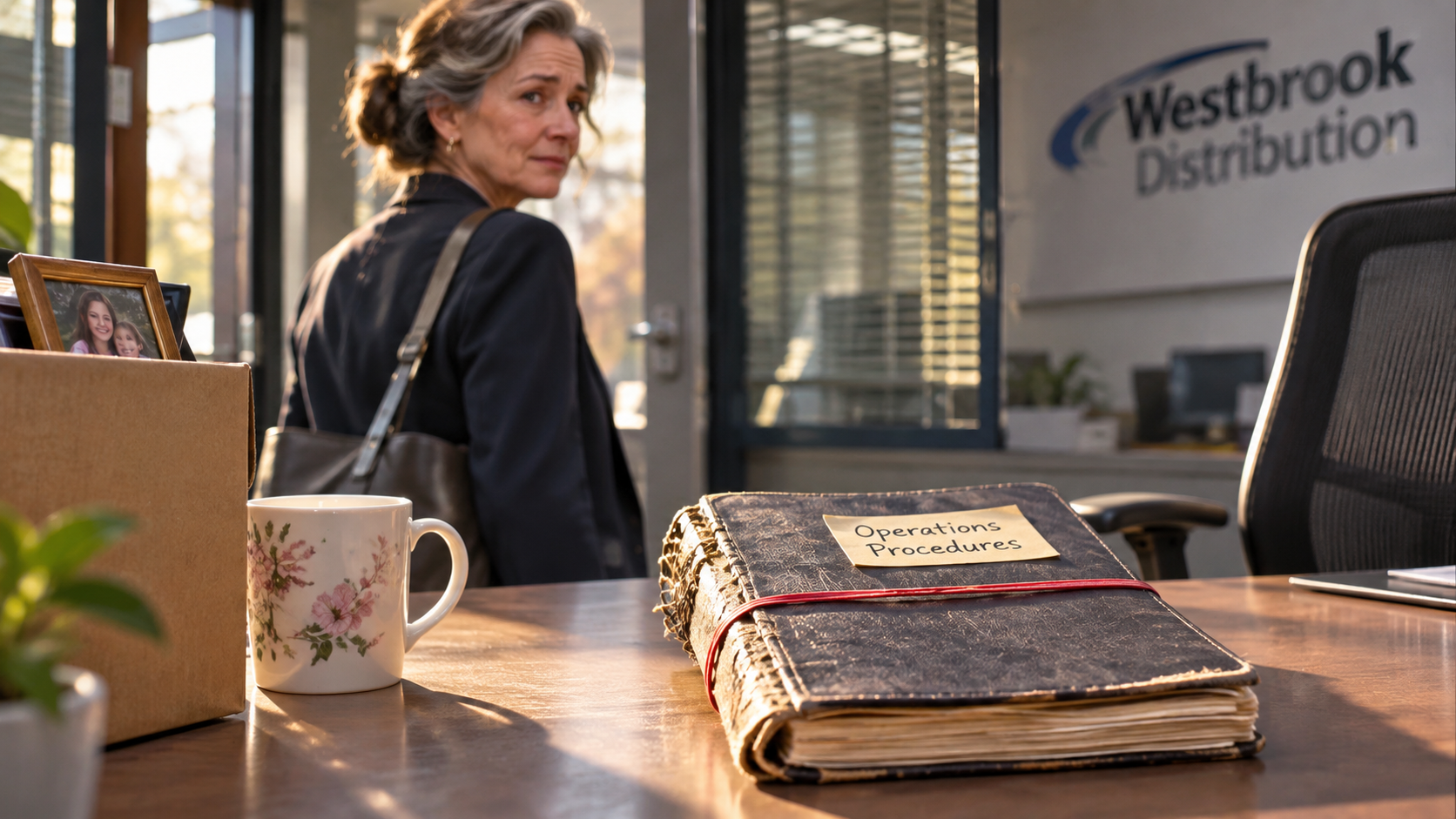
Linda Parker had worked at Westbrook Distribution for twenty-three years. Her job ended in a meeting that lasted four minutes.
She had started as an administrative assistant when the company had fewer than thirty employees. Over the years, she had learned nearly every part of the business.
She knew which suppliers delivered late and which customers paid early. She knew the drivers, the warehouse supervisors and the account managers by name. She knew how to fix a shipping problem before it became an expensive one.
She was usually the first one in. She made the coffee, read the overnight shipping reports and had solved two or three problems before most people arrived.
And she wrote everything down. Her notebook, thick and held together with a rubber band, went with her to every meeting.
Then the new operations director arrived.
Jason Reed was forty-one and had spent several years at a large logistics company. He believed Westbrook needed to modernize. He disliked old procedures, and he disliked being questioned.
Most of all, he disliked that Linda often knew the answer before he finished asking the question.
“That's not how we do things,” she told him more than once. Jason heard resistance to change. Linda saw a man making mistakes that didn't need to be made.
He hired younger staff and reorganized departments. He moved responsibilities from experienced people to people who had never worked in distribution. He replaced the order system in three weeks, a project Linda had warned would take three months.
Linda tried to help with all of it. Jason stopped listening.
Monday morning, Jason's office.
Linda brought her notebook. She assumed they were going to talk about the new shipping software. Jason didn't ask her to sit.
“We've decided to restructure your position,” he said.
“What does that mean?”
“It means your position is being eliminated.”
Jason opened a folder. “Your employment ends today. Human Resources will explain the details.”
Linda stared at him. “Did you look at my work before you decided this?”
“This isn't personal,” Jason said.
Linda closed her notebook. “Apparently not.”
By noon, the news had spread through the building. One warehouse supervisor called Jason to ask whether he was sure. “We need people who can adapt,” Jason told him.
Two drivers came up from the loading dock to shake her hand.
Linda packed a cardboard box with her photographs and a mug her daughter had given her. Then she looked at the notebook.
Every procedure she had worked out was in it, in her own hand: supplier quirks, customer habits, and a workaround for every system the company had ever used.
She left it on her desk. It belonged to the company.
At the front desk, she told the receptionist to take care of herself. Then she walked out.